

World AIDS Day: How aware is Gujarat about HIV/AIDS?

Summarized by AI; it may make mistakes. Check important info
Summarized by AI; it may make mistakes. Check important info

| Image: X (@UN) |
An old Doordarshan advertisement of actor Shabana Azmi visiting HIV+ patients and dispelling the questions of the reporters by saying, “Chhoone se AIDS nahi hota. Chhoone se sirf pyar failta hai.” (AIDS is not spread through touch. Only love spreads by touch). This ad went on to create a nationwide awareness about the life threatening condition. Or did it?
It is 2023 and the word ‘AIDS’ (Acquired Immune Deficiency Syndrome) still carries social stigma, myths, and fear with it. World AIDS Day, commemorated every year on Dec 1, is dedicated to raise awareness around understanding HIV/AIDS and international solidarity in the face of the pandemic.
Despite all this, only 29% of women and 36% of men in Gujarat have ‘comprehensive knowledge’ about HIV/AIDS, as per the National Family Health Survey (NFHS-5) (2019–21).
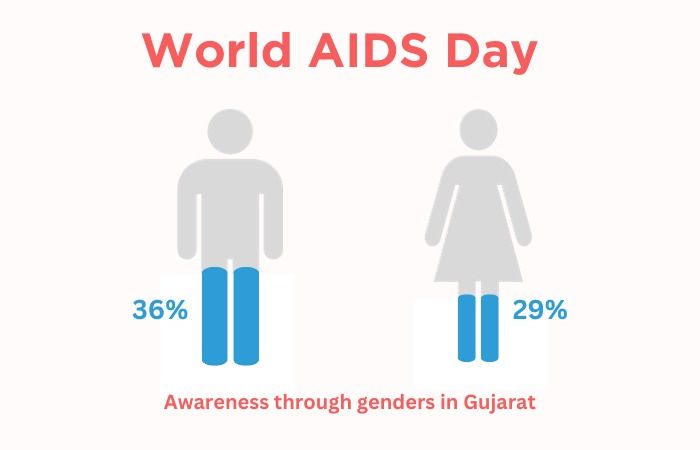
Dr Rajesh Gopal, additional project director at the Gujarat State AIDS Control Society said, “Under the Sustainable Development Goals (SDGs), it is planned to eradicate AIDS by 2030. On average, in Gujarat, there are four cases of AIDS for every one lakh individuals. The cases decreased to four, which were seven earlier (in 2017), as per a survey of the National AIDS Control Organisation (NACO).”
Awareness of HIV in Gujarat
66% of women in Gujarat have heard of HIV or AIDS. In urban areas, 87% know about HIV or AIDS, compared with 68% in rural areas. Women aged 25-29 and 30-39 are more likely (79%) than younger women aged 15-19 (72%) to have heard of HIV or AIDS.
Women with no schooling (58%), women with no regular exposure to media (64%), and women from other backward classes (72%) are less likely than other women to have heard of HIV or AIDS.
On the other hand, men are more likely than women to know about HIV or AIDS. 90% of men in Gujarat have heard of HIV or AIDS, including 95% in urban areas.
Knowledge of prevention and transmission
In Gujarat, men are much more likely than women to know how HIV/AIDS is transmitted and how to keep away from getting it.
For example, only 67% of women know that consistent condom use can help to prevent HIV/AIDS, compared with 83% of men. 64% of women know that having just one uninfected partner who has no other partners can reduce the chance of getting HIV/AIDS, compared to 76% of men, states the survey.
Stable trend of HIV in Gujarat
Gujarat saw its first HIV case in 1986; however, the trend has been stable in the state till now.
According to 2012 PPTCT (Prevention of Parent-To-Child Transmission) data, HIV positivity in Ahmedabad was low at 0.20% among the PPTCT attendees, with a stable trend.
Moreover, HIV positivity in Ahmedabad was low at 0.12% among the blood bank donors, with a stable trend, according to the blood bank data of 2012.
Gujarat HIV cases
A total of 155 clinics are active in Gujarat under the sexually transmitted disease (STD) control programme.
Till Sept 2023, 63,672 patients were recorded in government STD clinics, out of which 34,566 patients were given treatment.
A total of 8.21 lakh people were tested at the Integrated Counselling and Testing Centre (ICTC) between April and September this year, out of which 3,937 were HIV positive.
Myth busters
HIV targets the body’s white blood cells, weakening the immune system. This makes it easier to get sick with diseases like tuberculosis, infections, and some cancers.
HIV is spread from the body fluids of an infected person, including blood, breast milk, semen, and vaginal fluids. It is not spread by kisses, hugs, or sharing food. It can also spread from a mother to her baby, as per the World Health Organisation’s (WHO) website.
For more such updates and news on the go, follow us on Instagram | YouTube | Facebook


