





Patients face delays in critical care as Ahmedabad Civil Hospital struggles with ICU shortages
Updated: Sep 2nd, 2025


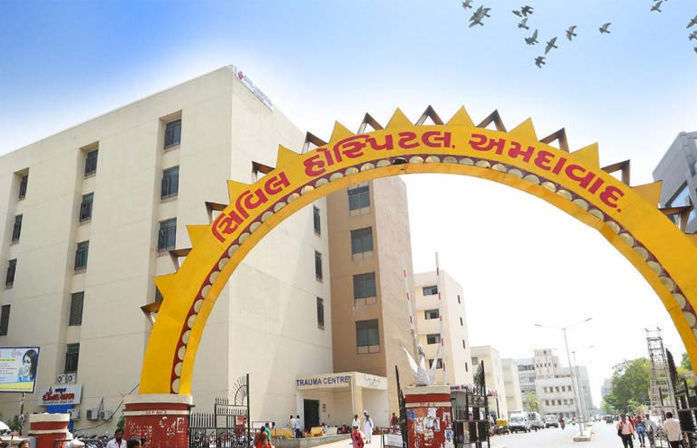
Ahmedabad Civil Hospital, the largest hospital in Asia, is facing an ongoing shortage of ventilators and intensive care unit (ICU) beds, leaving critically ill patients with no option but to seek treatment elsewhere. In emergency cases, families are often told there is a waiting period of three to four days for ICU admission, according to hospital sources.
The hospital serves patients not only from Gujarat but also from neighbouring states. While such shortages were expected during the COVID-19 crisis, the problem continues even during normal times, forcing patients to turn to semi-government or private facilities in the city.
Case highlights urgency
A recent case illustrates the challenge. An accident victim was brought to the hospital’s Trauma Centre, where he underwent X-ray, sonography, and CT scan. His condition was found to be critical, but staff informed the family that no ventilators were available and ICU admission was not immediately possible.
The patient’s relatives were told there was a waiting period for ICU admission. Ultimately, the family shifted him to SVP Hospital for further treatment. Social workers say such incidents show the continuing gap between patient demand and available infrastructure at Civil Hospital.
Hospital acknowledges capacity gap
Dr Rakesh Joshi, Superintendent of Ahmedabad Civil Hospital, confirmed that the hospital currently operates 110 ICU beds. He acknowledged that demand often exceeds capacity, particularly on weekends and holidays.
“Earlier, the waiting period used to be 20–25 days, which has now been reduced considerably,” Dr Joshi said. He added that at present, the waiting time can range from a few hours to two or three days.
Expansion plans underway
Authorities are banking on upcoming infrastructure to ease the pressure. The new 1,800-bed hospital under construction on the Civil Hospital campus will add 300 ICU beds.
“This will ensure there will never be a shortage of ICU beds,” Dr Joshi said. However, he cautioned that expanding ICU capacity is not only about adding machines. “Around 8–10 people are involved in managing medical, paramedical, technical, electrical, oxygen, and other aspects. With an increase in beds, the entire support infrastructure also needs to be set up.”
Ahmedabad Civil Hospital receives patients from three states of India as well as across Gujarat, yet even today, ICU waiting continues. During the COVID-19 period, such a situation was understandable, but now, even in normal times, patients are forced to wait for ICU admission.
A social worker from Behrampura cited a recent example: an accident victim was brought to the Trauma Center at Civil Hospital. After initial treatment, X-ray, sonography, and CT scan, his condition was found to be critical. The staff informed that ventilators were unavailable and he needed ICU admission.
However, upon inquiry, the patient’s relatives were told there was a waiting period for the ICU. Finally, the injured patient had to be shifted to SVP Hospital. This reflects the gravity of the situation — that the largest hospital in Asia continues to have ICU waiting. The government must take appropriate measures in this regard.
300 ICU beds to be added in the new hospital
Dr Rakesh Joshi, Superintendent of Ahmedabad Civil Hospital, said that currently the hospital has 110 ICU beds. On weekends, holidays, and other occasions, the ICU waiting may range from a few hours to two or three days.
Earlier, the waiting period used to be 20–25 days, which has now been reduced considerably. In the upcoming 1,800-bed hospital under construction, 300 ICU beds are planned. This will ensure there will never be a shortage of ICU beds. However, just installing a machine doesn’t make an ICU. Around 8–10 people are involved in managing medical, paramedical, technical, electrical, oxygen, and other aspects. Hence, with an increase in beds, the entire support infrastructure also needs to be set up.