




One year after AI171 crash, Pilot body continues to challenge preliminary investigation
Updated: Jun 11th, 2026


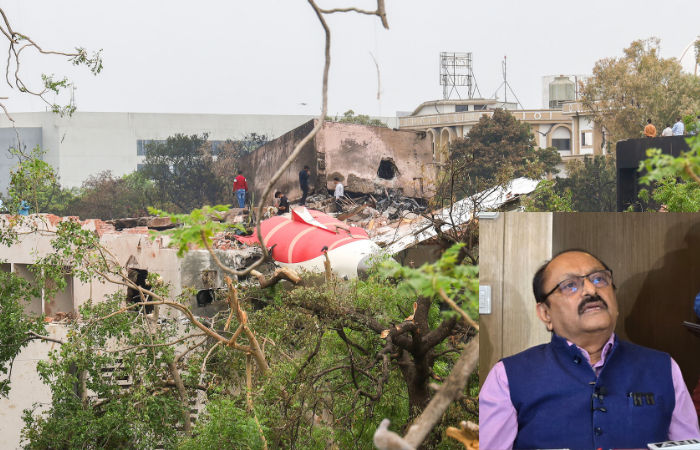
A year after the tragic crash of Air India Flight AI171, which claimed 260 lives shortly after take-off from Ahmedabad, questions surrounding the cause of the disaster continue to fuel debate within India's aviation community.
Captain C S Randhawa, President of the Federation of Indian Pilots (FIP), reiterated the pilots’ body’s position that the Boeing 787 may have suffered serious electrical failures and cautioned against conclusions that place responsibility on the flight crew.
Randhawa strongly criticised the preliminary report released by the Aircraft Accident Investigation Bureau (AAIB) in July last year, arguing that it led to speculation about pilot involvement after a brief cockpit voice recorder (CVR) extract regarding the movement of the aircraft's fuel control switches became public.
“The moment that short CVR transcript became public, a theory of pilot suicide started gaining traction,” Randhawa said. “We opposed that interpretation from the very beginning because it was not supported by the complete body of evidence.”
He claimed that the FIP immediately objected to what it described as premature conclusions and wrote multiple representations to both the Ministry of Civil Aviation and the AAIB.
Randhawa repeatedly stressed that investigators should focus more closely on the aircraft's electrical systems.
He pointed out that the Boeing 787 involved in the crash had reportedly experienced technical issues before operating the Ahmedabad-London service.
According to him, the aircraft had arrived in Ahmedabad from Delhi with a stabilizer-related defect and had undergone maintenance before being declared serviceable.
“The Boeing 787 is an aircraft that relies heavily on electrical architecture,” he said. “Its history worldwide includes incidents involving batteries, electrical panels, wiring systems, and electronic bays. These aspects need to be examined thoroughly before any conclusions are reached.”
To support his argument, Randhawa cited several historical incidents involving Boeing 787 aircraft, including battery failures, electrical fires, and water ingress into electronic equipment compartments.
He also referred to an Air India Dreamliner incident in Vienna on the same day as the AI 171 crash, claiming that engineers discovered significant water accumulation in an electronic bay before departure, preventing what he described as a potentially serious safety incident.
The pilots’ body also questioned the composition of the investigation team, arguing that more independent subject matter experts, including Boeing 787 pilots, engineers and flight safety specialists, should have been involved.
Randhawa acknowledged the inclusion of Captain RS Sandhu, a former Director of Operations and Boeing 787 examiner, but maintained that specialist participation remained limited.
He further alleged that attempts were made to investigate the mental health of Captain Sumit Sabharwal, one of the pilots who died in the crash, causing distress to his elderly father.
The Federation later joined Captain Sabharwal's father in approaching the Supreme Court seeking a judicial probe into the accident.
Randhawa said the court had observed that it was premature to blame the pilots before the investigation was complete, reinforcing the Federation’s demand that all technical possibilities be fully examined.
Randhawa also raised concerns about ACARS (Aircraft Communications Addressing and Reporting System) messages allegedly transmitted by the aircraft before departure.
He claimed these communications could provide important clues about the aircraft’s condition and questioned why they were not highlighted in the preliminary report.
“If those messages exist, they may provide valuable insight into what was happening inside the aircraft before take-off,” he said.
With the final investigation report still pending, Randhawa urged authorities not to release another interim report if it lacks definitive conclusions.
“If investigators need more time, they should take more time,” he said. “The objective is to discover the truth and improve safety.”
One year after the AI 171 crash, families of victims, aviation professionals and investigators are still waiting for answers. As the final report remains awaited, the debate over what caused the aircraft to fall from the sky just 32 seconds after take-off continues.
