




Licensed street vendors in Ahmedabad’s Bhadra area allege eviction despite court orders
Updated: Jan 27th, 2026


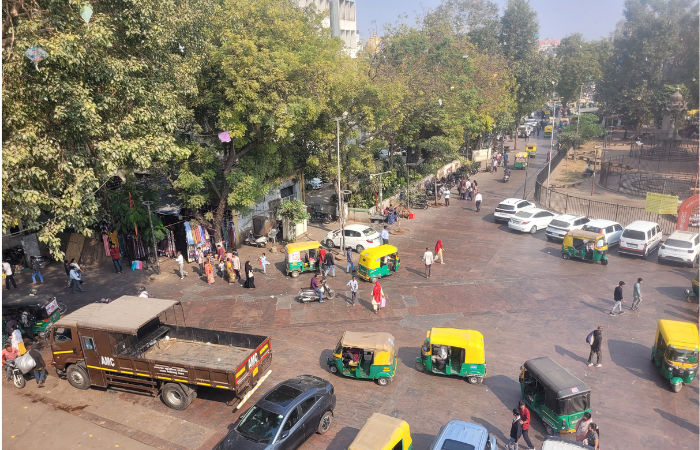
For nearly a decade, street vendors who have earned their livelihood for generations in Ahmedabad’s historic Bhadra area have been locked in a legal battle with the Amdavad Municipal Corporation (AMC). What began during the Bhadra Plaza redevelopment project in 2014 has now reached the Gujarat High Court.
Despite holding valid vending licences under the Street Vendors (Protection of Livelihood and Regulation of Street Vending) Act, hundreds of vendors allege that they are repeatedly removed on the pretext of traffic congestion and encroachment. Labour organisations such as the Self Employed Women’s Association (SEWA) have been fighting a legal battle on behalf of the vendors, citing documentary evidence dating back 60-70 years.
The dispute began in 2014 when AMC initiated road excavation and barricading around the Bhadra Kali Temple as part of the redevelopment project, directly impacting vendors who had been operating there for generations. After prolonged legal proceedings, licences were issued to 372 SEWA members recognising them as legitimate vendors.
However, vendors claim that despite court directions, the focus has shifted from rehabilitation to eviction. Recently, even after High Court orders mandating alternative arrangements, AMC relocated vendors to a largely deserted plot near Pankor Naka, far from the original marketplace. Vendors say this has destroyed their livelihoods, as the new location receives little to no footfall.
According to the high court order, three alternative plots A, B and C were identified. Vendors allege that while Plot C, located closer to the Bhadra area, is ideal, AMC is unwilling to allow them to operate there.
Responding to the issue, AMC Deputy Commissioner Ramya Bhatt said the matter is sub judice and that vendors have been accommodated at Plot A (Pankor Naka) and Plot B (Dhalgarwad) as per court directions. She also claimed that meetings were called with licensed vendors and SEWA representatives, but they did not attend.
Vendors’ representatives, however, refuted this claim, stating that repeated meetings were held with AMC officials, including the municipal commissioner, but authorities have consistently refused to allow vendors to operate either on the allotted footpaths or at Plot C.
Surendrasinh Rathod, president of the Bhadra street vendors’ association, said that despite holding valid vending cards, vendors are not being allowed to operate at designated locations. He added that after being shifted during Navratri, vendors have had no business for over 25 days, pushing families into severe financial distress. Many have reportedly pawned jewellery or taken high-interest loans to survive.
Local residents have also expressed concern. Poonam Shah, a citizen visiting the area, said she was surprised to see the Bhadra market empty and later learned that vendors had been diverted to Pankor Naka. “If these vendors are legal, the administration should support them. They are not getting even a fraction of the business they used to,” she said.
Several women vendors echoed similar concerns. Ramilaben, a licensed vendor, said that her daily income of ₹500–600 has dropped to zero since relocation. “The new plot is in a one-way, dilapidated area where customers don’t come. We are struggling even to feed our families,” she said.
Rajeshbhai, another vendors’ leader, said that 844 court-recognised vendors have been moved away from Bhadra Plaza. With no customers, many return home without a single sale after spending money on transport. Families that once earned ₹500–700 a day are now pawning gold jewellery to survive.
Devi-ben, who has been vending in Bhadra for 25 years, said vendors are being unfairly blamed for traffic problems caused by outside traders. “We are ready to operate within a four-foot space on the footpath without causing obstruction. All we ask is to be allowed to earn a dignified living,” she said.
Activists argue that development projects should not come at the cost of livelihoods. If the government cannot provide alternative employment, they say, it has no moral right to take away the means of survival of self-employed citizens who earn their living lawfully.
