




INSV Kaundinya sets sail from Porbandar on maiden voyage to Oman
Updated: Dec 30th, 2025


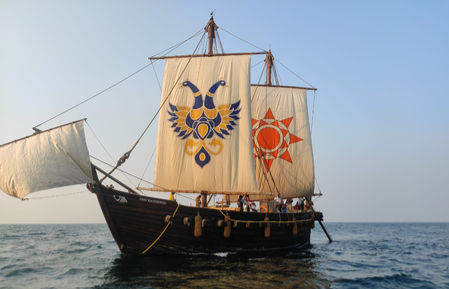
The Indian Navy’s traditional sailing vessel, INSV Kaundinya, was flagged off from Porbandar on its maiden voyage to Muscat, Oman, marking a symbolic effort to revive India’s ancient maritime heritage. The flag-off ceremony was held in the presence of senior naval officers and diplomatic representatives.
Revival of ancient shipbuilding traditions
INSV Kaundinya has been constructed using a 2,000-year-old stitched-ship technique, with no nails used in its assembly. The design draws inspiration from paintings found in the Ajanta Caves, reflecting historical methods of shipbuilding that once enabled long-distance maritime travel from India’s western coast.
According to the Navy, the vessel represents India’s legacy of indigenous ship construction, seamanship and maritime navigation. Built entirely of wood, it employs centuries-old natural materials and traditional methods that are rarely used in modern naval architecture.
Flag-off ceremony in Porbandar
The ceremony was attended by the Ambassador of Oman to India, Issa Saleh Al Shibani, Flag Officer Commanding-in-Chief of the Western Naval Command Vice Admiral R. Swaminathan, and other senior naval officials. The presence of Omani and Indian dignitaries underlined the historical and contemporary maritime links between the two countries.
Retracing historic sea routes
The voyage is intended to retrace ancient sea routes that once connected India with Oman. Historically, these routes facilitated not only trade but also cultural exchange across the Indian Ocean. The Navy said the expedition is expected to further strengthen bonds of friendship and trust between India and Oman.
Crew, sailing challenges and specialised training
The vessel is crewed by four naval officers and 13 sailors. Skipper Commander Vikas Shoran described sailing Kaundinya as “like travelling back in time”, noting that the ship is based on 2,000-year-old technology.
He said specialised training was required for both harbour trials and open-sea sailing, as there was no prior experience of how the vessel would behave under different wind conditions. The square-rig sail used on Kaundinya is significantly different from those on modern ships and requires a high level of skill to operate.
Design inspired by Ajanta Cave paintings
Naval Architect Commander Hemant Kumar said the project involved a specialised reconstruction based on a fifth-century painting found in the Ajanta Caves. As the artwork did not provide precise measurements or dimensions, the design process relied heavily on interpretation, making it particularly challenging.
To ensure seaworthiness, the vessel was tested using modern scientific methods to assess its ability to withstand sea waves and wind pressure. Model testing was carried out at the Department of Ocean Engineering, IIT Madras.
The construction of INSV Kaundinya took approximately one and a half years, combining ancient craftsmanship with contemporary testing techniques to bring a historic maritime concept back to life.
