




Indian Railways reveals first look of Mumbai-Ahmedabad Bullet Train
Updated: May 18th, 2026


 |
| Image: X (@ANI) |
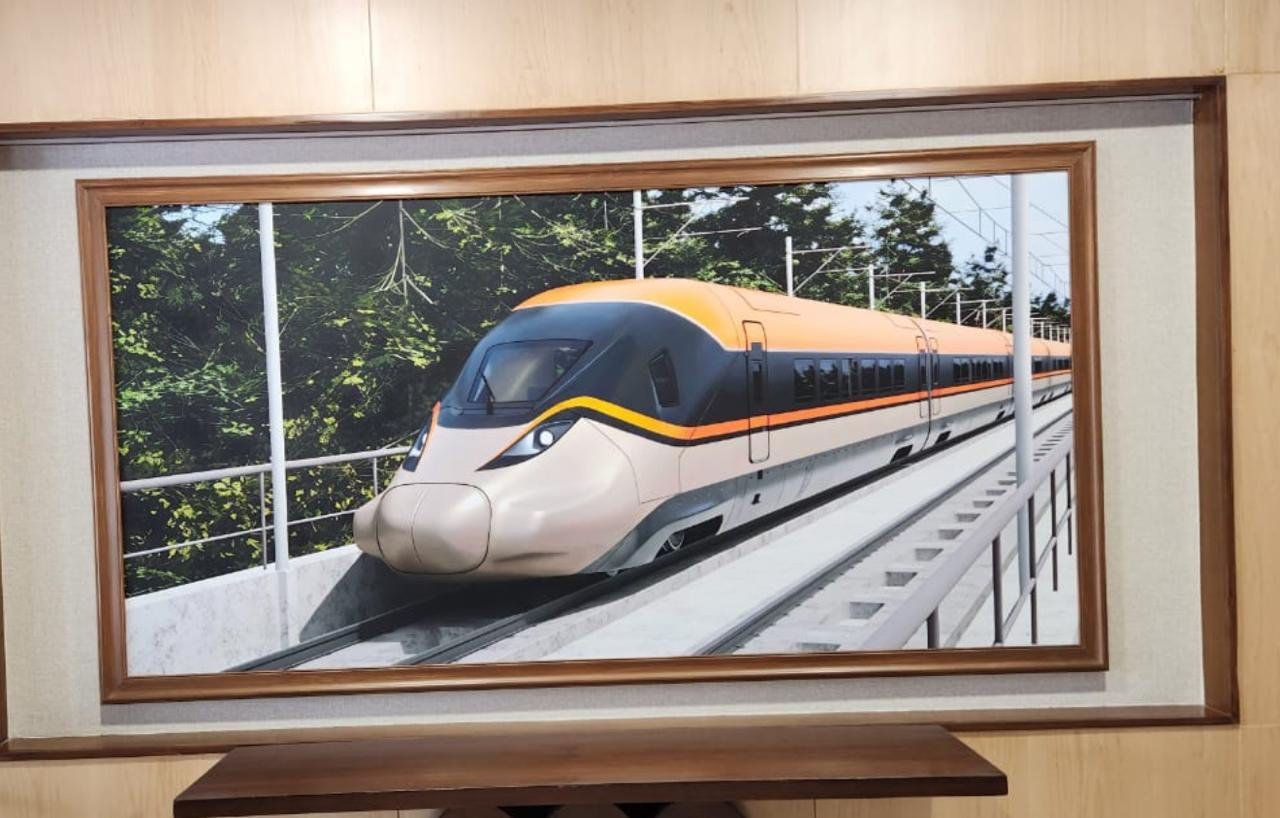
Indian Railways on Monday revealed the first official look of the Mumbai-Ahmedabad Bullet Train, offering a glimpse of the high-speed train set planned for India’s maiden bullet train corridor.
Stretching nearly 508 kilometres, the Mumbai-Ahmedabad High-Speed Rail corridor will link 12 stations, including Mumbai, Thane, Surat, Vadodara, Ahmedabad and Sabarmati.
Designed for speeds of up to 320 kmph, the bullet train network is expected to drastically cut travel time between Mumbai and Ahmedabad while introducing India’s first dedicated high-speed rail system.
A picture of the country's first proposed bullet train has been displayed at the Ministry of Railways. The picture has been installed at Gate Number 4: Indian Railways pic.twitter.com/LcbwMstDuw
— ANI (@ANI) May 18, 2026
The development comes amid rapid progress on the Mumbai-Ahmedabad High Speed Rail project, with five heavy portal beams recently launched over the Ahmedabad-Vadodara railway line in the Maninagar area of Ahmedabad on May 4, completing a critical construction phase within just 22 days.
The precast-prestressed beams were launched in a planned sequence on April 8, 13, 19, 24, and 29, in coordination with Indian Railways.
Each installation was carried out in approximately three and a half hours, reducing the duration compared with earlier nine-hour traffic blocks.
Addressing the development, officials said: “All five (5) precast-prestressed heavy portal beams (girders) have been successfully launched over the Ahmedabad-Vadodara railway line in Maninagar… within just 22 days.”
The first launch on April 8 involved the heaviest beam, weighing about 1,360 metric tonnes.
Officials described it as “one of the heaviest lifts ever undertaken over operational railway lines.”
The remaining beams weighed between 1,170 and 1,360 metric tonnes, making the operation one of the most complex structural exercises conducted on railway infrastructure.
The Maninagar section involves the high-speed rail alignment crossing existing tracks at an elevated level with a skewed geometry and limited working space.
The span between piers ranges from about 30 to 34 metres. “The space between the two piers is also relatively large… which further demands a strong and rigid supporting system like portal beams,” officials noted.
Each beam measures 34 metres in length with a cross-section of 5.5 metres by 4.5 metres and was precast on site as an integrated unit before erection.
The portal beams are designed to span multiple active railway lines, including the Ahmedabad-Vadodara up, down and third lines.
Their size and structural capacity help limit deflection and maintain alignment, ensuring safe railway operations beneath the elevated corridor.
The launches were carried out using a 2,200 metric tonne crawler crane as the primary equipment, deployed for the first time over Indian railway tracks.
Despite challenges such as restricted space, overhead electrification systems and ongoing train movements, the work was completed with officials describing it as “high precision, strict safety checks, and continuous monitoring.”
Officials said the operation reflects the detailed planning and coordination required to execute heavy engineering work over one of the country’s busiest railway routes without disrupting regular services.
(with inputs from syndicated feed)
