





Gujarat to witness statewide showers till July 15
As of July 8 morning, Gujarat has received nearly 47% of the average monsoon rainfall
Updated: Jul 8th, 2025


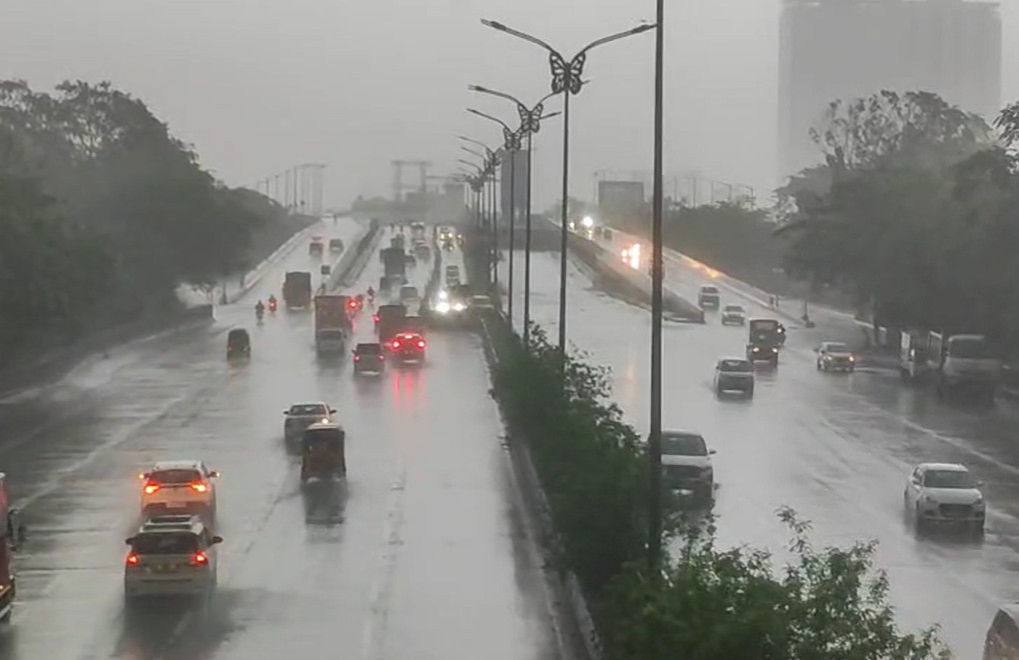
Heavy to very heavy rains are likely in Narmada, Surat, Navsari, Valsad, Daman, and Dadra & Nagar Haveli on Wednesday.
Heavy rains on Wednesday across: Panchmahal, Dahod, Vadodara, Chhotaudepur, Bharuch, Dang, Tapi, Amreli, Bhavnagar and Botad.
Light thunderstorm with lightning and surface wind 30-40 kmph accompanied with light to moderate rain likely across:
Banaskantha, Patan, Mehsana, Sabarkantha, Gandhinagar, Aravalli, Kheda, Ahmedabad, Anand, Panchmahal, Dahod and Mahisagar, Vadodara, Chhotaudepur, Narmada, Bharuch, Surat, Dang, Tapi, Navsari, Valsad, Daman, Dadra & Nagar Haveli, Surendranagar, Rajkot, Jamnagar, Porbandar, Junagadh, Amreli, Bhavnagar, Morbi, Dwarka, Gir Somnath, Botad, Kutch and Diu.
Borsad tops rainfall chart
Gujarat witnessed rainfall across 153 talukas in the last 24 hours (till Tuesday morning), though only 12 talukas recorded more than one inch of precipitation. Heavier showers were concentrated in select regions, with Borsad in central Gujarat receiving the highest downpour at 99 mm, said officials on Tuesday.
Godhra followed with 95 mm, while Gandhidham and Mandvi (Kutch) recorded 58 mm and 57 mm respectively. Other talukas with significant rainfall included Khambhalia (49 mm) and Bhachau (48 mm).
According to the India Meteorological Department (IMD), more rain is on the horizon for parts of the state. As of July 8 morning, Gujarat has received nearly 47% of the average monsoon rainfall, based on the 10-year seasonal benchmark. Gujarat has experienced a robust start to the monsoon season. The state had already received roughly 266-324 mm of rain since June 1, about 37-40% of its seasonal average.
This followed an earlier report indicating an exceptionally wet June, with cumulative rainfall running nearly 11 per cent above the long-term average for all India. Regionally, rainfall has varied widely: South Gujarat has recorded over 23 inches (nearly double the norm), Central‑East around 12 inches, Saurashtra around 245 mm, and Kutch approximately 142 mm. Daily charts show nearly 47% of the expected June–September total across the state had fallen by July 8.
The IMD forecasts have said that July rainfall will exceed 106 per cent of the long-period average for Gujarat, bringing more widespread and, at times, heavy to very heavy showers through mid‑month.
The Gujarat government has stepped up monsoon preparedness in response to the above-normal rainfall across the state.
Chief Minister Bhupendra Patel has directed officials to carry out immediate road repairs, especially in flood-prone rural and urban areas, treating the situation on a ‘war footing’.
The State Emergency Operation Centre (SEOC) is closely monitoring rainfall and reservoir levels, while disaster response teams, including NDRF and SDRF units, have been deployed in vulnerable districts.
Control rooms have been activated round-the-clock, and district administrations have been instructed to ensure quick drainage in low-lying areas, provide temporary shelters, and coordinate with health and power departments to prevent service disruptions.
Over 50% of Kharif sowing completed in Gujarat
As of July 7, 2025, due to widespread rainfall during the current monsoon season, farmers in Gujarat have completed Kharif sowing over 50.32% of the cultivable area. The highest sowing has been reported for groundnut, covering 17.59 lakh hectares.
Additionally, 17.10 lakh hectares have been sown with cotton, 3.10 lakh hectares with fodder, 1.58 lakh hectares with soybean, 1.03 lakh hectares with vegetables, and 80,000 hectares with maize. Other major crops sown so far include bajra (pearl millet), paddy, tur (pigeon pea), moong (green gram), math (horse gram), castor, cluster bean, and jowar (sorghum), taking the total sown area to 43.05 lakh hectares — which is 50.32% of the total targeted area — according to the Agriculture Department.
Due to the continuous heavy rainfall, 34 dams in the state have been placed on high alert, 20 on alert, and 19 under warning status.
The Sardar Sarovar Dam, vital to the state’s water supply, currently holds 48.21% of its total water storage capacity.
As part of the ongoing monsoon response, local administrative bodies, the National Disaster Response Force (NDRF), and State Disaster Response Force (SDRF) have safely relocated 4,278 citizens and rescued 685 individuals across 10 districts so far. Most roads and state transport (ST) bus routes are currently operational.
(With inputs from syndicated feed)