





Flooded salt pans in Suigam and Santalpur cause losses worth crores to the salt industry
Updated: Sep 14th, 2025


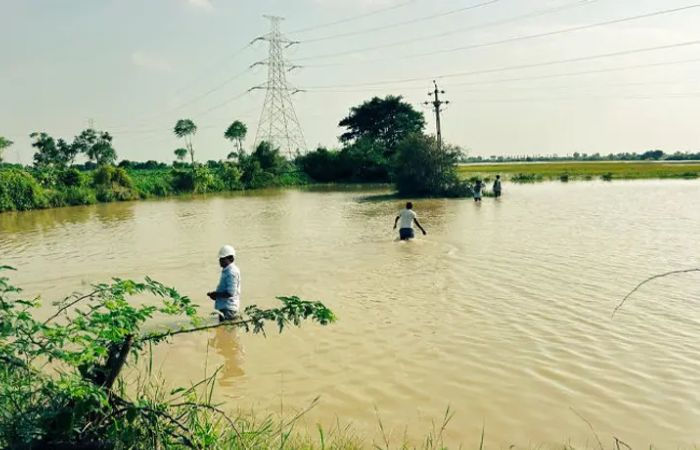
Heavy rains across Gujarat last week, destroyed small and large salt pans of Suigam in Banaskantha and Santalpur in Patan, affecting the livelihood of thousands of salt pan workers (Agariyas).
With water accumulating in the small farms and company units where salt is cultivated, the salt industry is set to suffer losses worth crores of rupees. Tragically, around 5,000 Agariya families from Boru, Masali, and Madhavpur villages of Santalpur (Patan) and Suigam, who survive by working in salt pans, are facing dire conditions. With salt production delayed by two to three months, there are signs that the overall output could drop by hundreds of thousands of tonnes.
The thriving salt industry in Patan district’s Santalpur, Banaskantha’s Suigam, and Adesara in Kutch has been hit hard by nature’s fury. In the Little Rann alone, over 22 km of salt fields, and in the Great Rann, over 20 km of area have been submerged.
Work to cultivate salt will be delayed by at least two to three months, as water levels have risen by 6–7 feet. There is no option other than waiting for natural drainage. Under these circumstances, the usual practice of beginning work in Navratri is ruled out this year.
If conditions improve after Diwali or Dev Diwali, Agariyas may be able to re-enter the Rann to begin work. However, heavy rainfall has already damaged salt pan embankments, while over 70% of the borewells, usually dug 90–100 feet deep to draw brine, have failed.
24 lakh tonnes of salt from 1,200 small farms
Near Santalpur in the Little Rann of Kutch, there are about 1,200 small farms, owned by Agariyas themselves. Each farm typically produces around 2,000 tonnes of salt, resulting in an average annual production of about 24 lakh tonnes for this area alone. Nearly 3,600 Agariya families depend on these farms for employment. Now, they are likely to get work for barely one and a half months.
Continued inflow of Banas River worsens the situation
About a week ago, Suigam received 17 inches of rainfall, turning the area into a waterlogged desert. The Boru Rann, part of the Banaskantha district (considered part of the Great Rann of Kutch), has around 700 small units where nearly 1,500 families are engaged in salt farming. With excessive waterlogging and continued inflow from the Banas River, the situation has become even more critical.
Another major blow after 2015 and 2017
The salt industry has faced devastating losses due to heavy rains in the past as well, especially in 2015 and 2017. Eight years later, the monsoon of 2025 has revived those bitter memories for Agariyas, entrepreneurs, and the entire salt sector. For Agariyas, who earn barely ₹400 a day, the crisis has made their lives miserable, while the industry as a whole faces massive financial setbacks running into crores.