

CAG report flags rising debt and structural concerns for Gujarat, fiscal health under pressure

Summarized by AI; it may make mistakes. Check important info
Summarized by AI; it may make mistakes. Check important info

| Source: CAG Report |
The Comptroller and Auditor General (CAG) report for Gujarat for the financial year 2024–25, tabled in the state Assembly, has flagged a significant decline in the state’s revenue surplus, raising concerns over its fiscal position. The report notes a sharp 43.41% drop in revenue surplus, which fell from ₹33,477 crore in 2023–24 to ₹18,943 crore in 2024–25.
The decline has been attributed primarily to a substantial increase in revenue expenditure by ₹10,326 crore, coupled with a drop in revenue receipts by ₹4,208 crore. While the state continues to maintain a surplus, the steep fall compared to the previous year indicates weakening fiscal strength.
"The 43.41% decrease in Revenue Surplus was due to ₹10,326 crore increase in revenue expenditure and 4,208 crore decrease in revenue receipts as compared to FY 2023-24. This tightened the fiscal space and thus market borrowings increased to finance the capital expenditure," said the report.
Rising public debt
The report also highlights a steady rise in Gujarat’s public debt, which has now reached ₹3.80 lakh crore—an increase of around ₹22,000 crore from the previous year. Market borrowings alone stand at ₹3.11 lakh crore, reflecting a rise of nearly ₹16,000 crore, underlining the state’s growing reliance on loans.
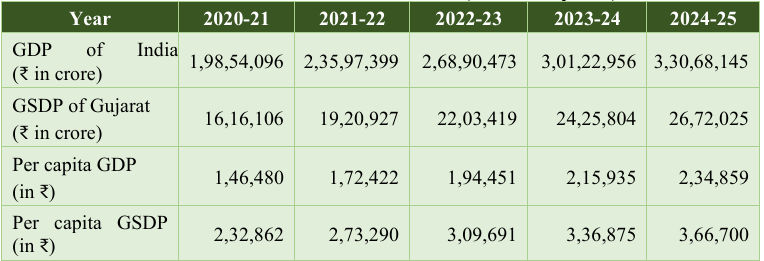
Despite these concerns, Gujarat’s economy continues to expand, with the Gross State Domestic Product (GSDP) touching ₹26.72 lakh crore, contributing around 8% to India’s GDP. The state’s per capita income stands at ₹3.66 lakh, significantly higher than the national average of ₹2.34 lakh. Gujarat also performs relatively well on key social indicators, with a literacy rate of 84.6% and a lower poverty rate of 11.66%.
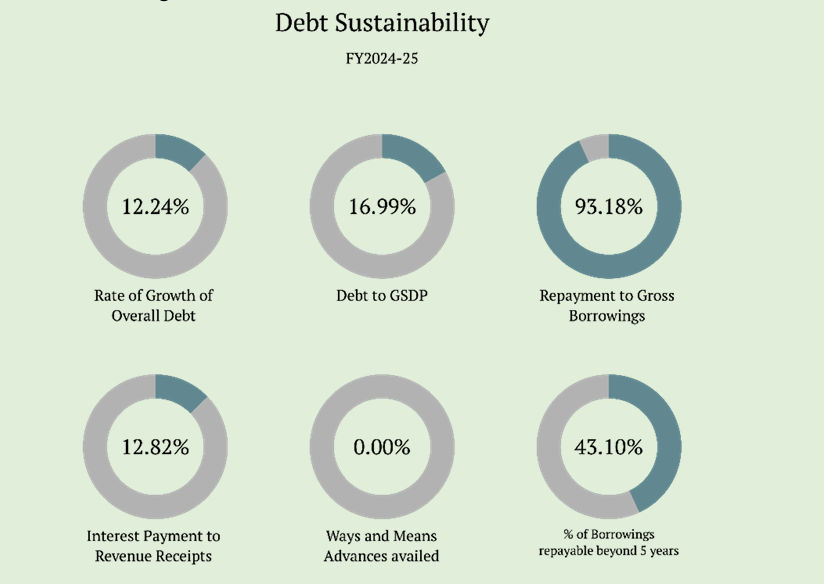
However, the report raises red flags on debt sustainability. Gujarat’s total debt stands at 16.99% of its GSDP, and notably, 12.82% of the state’s revenue receipts are being spent solely on interest payments of past debt. This indicates that a considerable portion of earnings is being diverted away from development expenditure.
The shrinking revenue surplus has also narrowed the state’s fiscal space, forcing the government to rely more on borrowings to fund capital expenditure such as infrastructure projects. The report notes a debt growth rate of 12.24%, signalling a steady increase in financial burden.
 |
| Source: CAG Report |
 |
| Source: CAG Report |
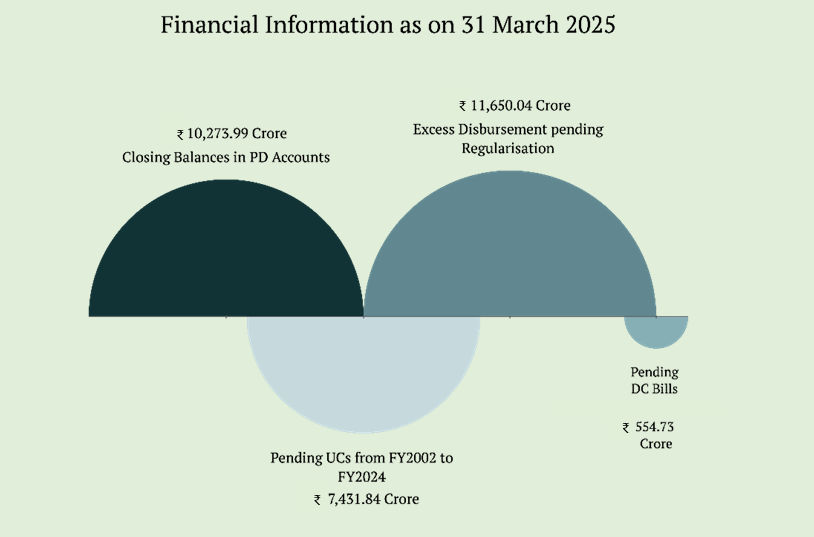
Administrative inefficiencies have also come under scrutiny. Utilisation certificates worth ₹7,431.84 crore, pending since 2002, remain unsettled, raising concerns about financial accountability. Additionally, excess expenditure exceeding ₹11,650 crore is yet to be regularised, pointing to procedural delays.
Disparities in demographics
On the demographic front, Gujarat continues to urbanise rapidly, with 50.29% of its population now residing in urban areas—well above the national average of 35.7%. The state has performed better than the national average in key health indicators such as infant and maternal mortality rates.
However, the sex ratio remains a major concern. With only 904 females per 1,000 males, Gujarat lags significantly behind the national average of 947, highlighting persistent social challenges.
 | |
| Source: CAG Report |
The CAG report serves as a cautionary note, indicating that while Gujarat’s economic growth and income levels remain strong, rising expenditure, increasing debt, and weakening revenue surplus could pose challenges ahead. Experts suggest that unless the state improves revenue generation and strengthens fiscal discipline, funding for future development projects may come under strain.
Overall, the findings place the “Gujarat model” at a critical juncture—balancing strong economic performance against emerging fiscal and social pressures.


