





Ahmedabad plane crash prompts forensic experts to push for national dental records centre
NFSU hosts global meet on forensic odontology
Updated: Sep 13th, 2025


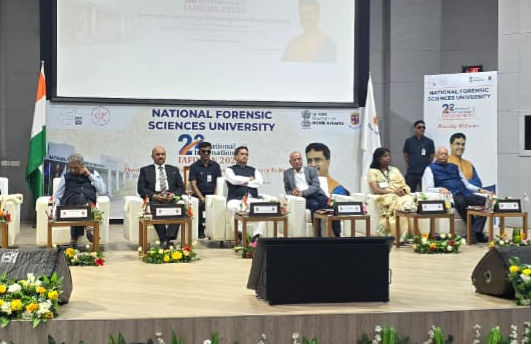
The recent Ahmedabad plane crash, in which several victims were charred beyond recognition, has exposed a critical gap in India’s disaster-response framework and prompted forensic scientists to call for the systematic use of dental records to identify victims in future tragedies.
Investigators involved in the crash confirmed that dental evidence was not used in the identification process—a shortcoming that has now become the focus of experts gathered at the National Forensic Sciences University (NFSU) in Gandhinagar, where the 22nd National and 2nd International Conference of the Indian Association of Forensic Odontology (IAFO) opened on Saturday, September 13, and continues until Sunday, September 14.
Turning tragedy into a call for reform
“The plane crash highlighted how dependent we still are on fingerprints and DNA, both of which can be destroyed or take considerable time to process,” said Dr J M Vyas, Vice-Chancellor of NFSU. “Dental structures survive extreme heat and decomposition and can provide rapid, reliable identification. This conference is our opportunity to ensure such tools become part of standard disaster protocols in India.”
More than 300 experts from India and abroad, including specialists from the United States, the United Kingdom and Norway, are attending the two-day meet, which carries the theme ‘Advancing Forensic Odontology: From Theory to Reality’. About 170 scientific presentations are scheduled.
Tripura Chief Minister Dr Manik Saha, Gujarat Health Minister Rushikesh Patel, and CID DGP Manoj Agarwal joined Dr Vyas in inaugurating the conference.
Push for a national dental records centre
A key proposal under discussion is the creation of a National Dental Records Centre to make dental histories readily accessible to forensic teams. “At present, investigators must depend on individual dentists or families for records, a process that is often slow or impossible when relatives are missing,” Dr Vyas said. “A central database would speed up identification in mass-casualty incidents and also help clinicians avoid dangerous drug interactions during medical treatment.”