




Ahmedabad loses cycle culture as dedicated tracks disappear from city roads
Updated: May 27th, 2026


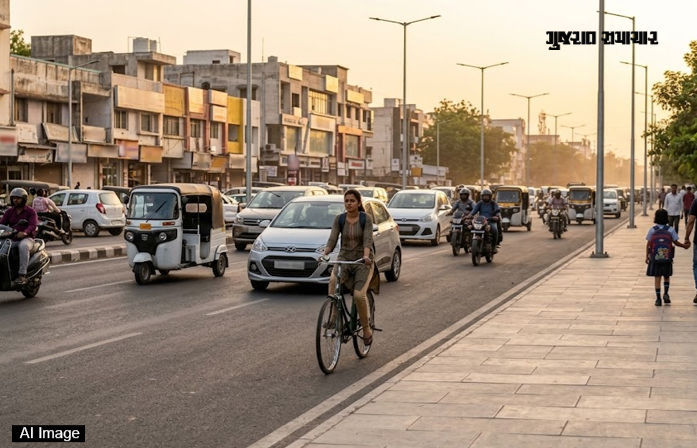
Once promoted globally as an affordable, sustainable, and eco-friendly mode of transport, the bicycle is steadily disappearing from roads in Ahmedabad as the city faces an acute lack of dedicated cycling infrastructure.
While several European nations continue to encourage cycling even after rapid motorisation, cyclists in Ahmedabad increasingly find themselves pushed onto congested roads without dedicated lanes, prompting many residents to shift to two-wheelers instead.
Urban planners and cyclists say that despite Ahmedabad’s emergence as a major metropolitan and “smart city”, the city currently does not have a single functional cycle track.
Countries such as the Netherlands, Denmark, France, Germany, Sweden, and Finland continue to see between 10% and 30% of people commuting to schools, colleges and workplaces by bicycle.
However, in India, bicycles are increasingly viewed as a necessity-driven mode of transport rather than a preferred one, experts said.
Cyclists and civic observers pointed out that instead of expanding awareness and infrastructure for sustainable transport, authorities have gradually removed cycling tracks from major roads in Ahmedabad.
During 2019, dedicated cycle tracks were developed on stretches between Narol and Naroda as well as near the Judges' Bungalows. However, both were later dismantled.
Activists further noted that none of the seven newly developed “iconic roads” in Ahmedabad, built at a reported cost of ₹405 crore, included dedicated cycling infrastructure in their designs.
As a result, cyclists are now forced to navigate heavily crowded roads alongside fast-moving vehicles, raising safety concerns.
Parents, especially, are increasingly reluctant to allow children to travel to schools or tuition classes by bicycle due to fears of accidents.
Cycling culture in the city has also witnessed a sharp decline over the past decade, according to bicycle traders.
Shop owners said that where ordinary bicycle stores earlier sold more than 500 bicycles every month, current sales have dropped to around 50 to 100 units monthly.
They said bicycles are now mainly purchased by children, labourers and economically weaker students, while even schoolchildren in classes 6 and 7 are increasingly shifting towards mopeds and scooters.
Cyclists also pointed to the contrast with several Indian cities that continue to invest in cycling infrastructure.
According to available data, Chandigarh has nearly 200 km of cycle tracks, while the Agra-Etawah cycle highway stretches over 207 km.
Pune has around 80 km of cycling tracks, while Hyderabad has developed a 23-km solar-roof cycle corridor.
Urban mobility experts say that with growing concerns over fuel prices, traffic congestion and pollution, Indian cities may eventually need to revisit non-motorised transport planning and invest more seriously in cycling infrastructure.
