




Ahmedabad Cyber Crime busts Thakrar gang, traces Chinese syndicate laundering ₹16 crore
Updated: Aug 19th, 2025


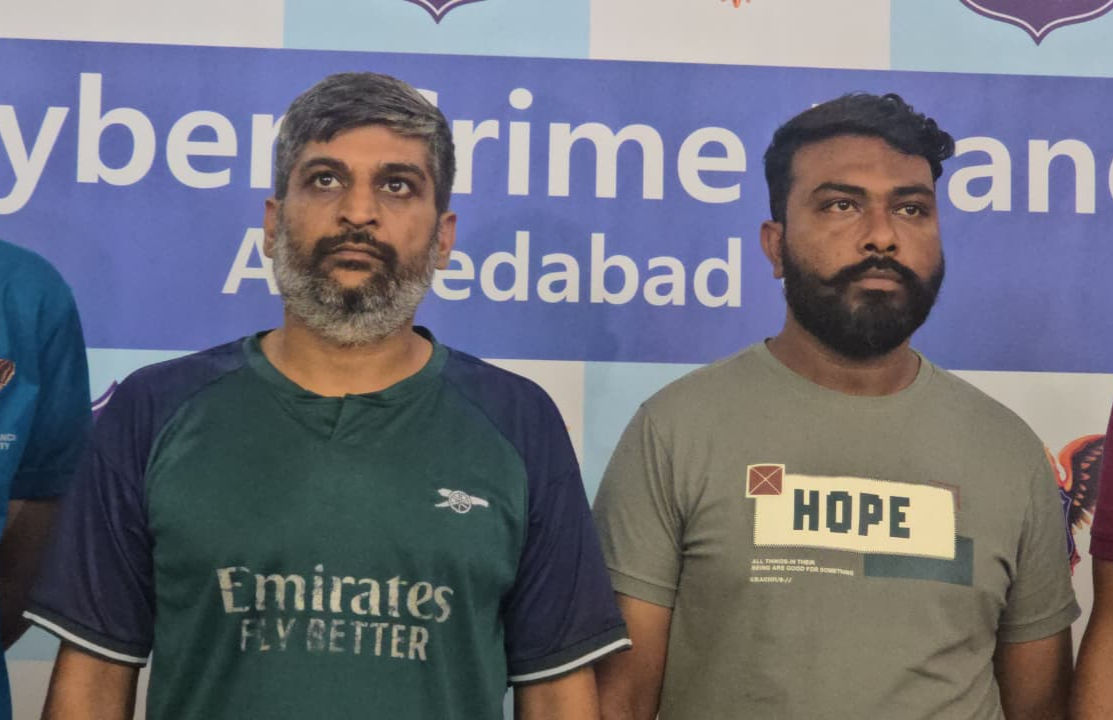 |
| Two accused of Thakrar gang in Ahmedabad Crime Branch custody |
In a breakthrough against cross-border cyber fraud, Ahmedabad’s Cyber Crime Branch has invoked the stringent Gujarat Control of Terrorism and Organised Crime (GUJCTOC) Act against a city-based syndicate accused of laundering crores of rupees for Chinese gangs. Investigators say the 'Thakrar gang' converted fraud money into cryptocurrency before routing it abroad to scammers operating from Cambodia and Myanmar.
Those arrested today include brothers Sawant and Govind Raval, while four were eariler arrested by Cyber cell in January in which two identified as Dhaval Thakrar and Brijrajsinh Gadhvi are in judicial custody, while Keval Gadhvi and Hasmukh Naseet are on bail. Apart from them, the Dubai-based Milan, said to be the gang’s link to Chinese operatives, has been declared an absconder.
Case filed in Naranpura
The case was first registered at Naranpura police station in 2024 under sections of the Bharatiya Nyaya Sanhita and the IT Act related to digital arrest fraud. Given the seriousness and interstate implications, the investigation was transferred to the Cyber Crime Branch.
What began as a single FIR soon unfolded into a web of fraud spanning multiple states, with losses exceeding ₹16 crore reported on the National Cyber Crime Reporting Portal.
A network with global links
Police have so far named seven accused:
Sawant Thakrar and Dhaval Thakrar, alleged masterminds.
Govind Rawal, aide.
Brijrajsinh Gadhvi and Keval Gadhvi, cash handlers.
Hasmukh Naseet, converter of cash into crypto.
Milan, a Dubai-based operative linking the gang to Chinese handlers (declared absconding).
The Thakrar brothers allegedly ran the operation from their office in Ambawadi, Ahmedabad.
Modus operandi: From mule accounts to crypto wallets
Investigators say the gang relied on three types of 'agents':
1. Mule account providers – Indian citizens who lent their bank accounts for deposits.
2. Cash movers – Operatives who withdrew the money via ATMs, cheques, and cash systems.
3. SIM suppliers – Providers of phone numbers used for fraud calls and OTP bypasses.
Once the funds were withdrawn, they were routed through Angadia couriers to Brijraj Gadhvi and Hasmukh Naseet. The duo then converted the sums into USDT cryptocurrency, which was transferred to wallets linked to Dubai-based Milan or directly to Chinese handlers abroad.
Seizures: Cash, Passbooks and Crypto Trails
The gang is suspected of carrying out these operations from an office in Ambawadi, Ahmedabad, which was raided by police. The raid led to the recovery of 65 bank passbooks, 158 cheque books, 45 debit/credit cards, 12 mobile phones, 49 SIM cards, a cash-counting machine, ₹37.11 lakh in cash, and valuables totalling ₹37.57 lakh.
Officials say the documentation revealed links to hundreds of mule accounts and crypto transfers used to launder victims’ money.
Fraud trail: victims across India
The accused are suspected in multiple ongoing cases:
₹59 lakh investment fraud (Ahmedabad Cyber Crime, 2025)
₹1.48 crore digital arrest case (Ahmedabad Cyber Crime, 2024)
₹36.5 lakh fraud (Gandhidham, 2025)
₹36 lakh investment scam (Ahmedabad, 2025)
Further, 404 complaints linked to the gang have surfaced on the NCRP portal with an estimated fraud value of over ₹16 crore, involving victims from Tamil Nadu, Karnataka, West Bengal, Bihar, Maharashtra, Kerala, Delhi, Punjab, and Arunachal Pradesh, among others.
Chinese gangs and the 'Grey Zone' of cybercrime
Police believe the racket was part of a larger network controlled by Chinese operators based in Cambodia and Myanmar. These gangs are notorious for digital arrest scams, share market frauds and part-time job cons, where victims are coerced into paying large sums.
Ahmedabad Police officials admitted the racket’s international link made it harder to track. “Local agents like the Thakrar brothers are critical cogs in this machinery. They ensure the stolen money moves seamlessly from Indian victims to Chinese wallets abroad,” a senior officer said.
Legal edge: Why GUJCTOC was invoked
Officials added sections of the Gujarat Control of Terrorism and Organised Crime Act, 2015, to the case, noting the gang’s structured and syndicate-like functioning. The law allows extended detention, stricter bail provisions, and seizure of properties gained from organised crime.
Advisory: Don’t be a mule
The Cyber Crime Branch issued a strong public warning:
–Don’t share bank accounts for “commission-based jobs”.
–Don’t sell SIM cards – they are used for scam call centres and OTP bypasses.
–Don’t rent crypto wallets – they can be misused for hawala-like transfers and even terror financing.
So far, two accused have been arrested, while efforts are on to nab the rest, including Dubai-based Milan. Police say more victims and accomplices are likely to surface.
“The scale of this network shows how local operatives and international gangs are working hand in glove. We are committed to cracking down on such organised crime,” said senior officer.
