




Ahmedabad air crash ‘fire reached 1000°C within seconds’, say fire and emergency officers
Updated: Jun 13th, 2025


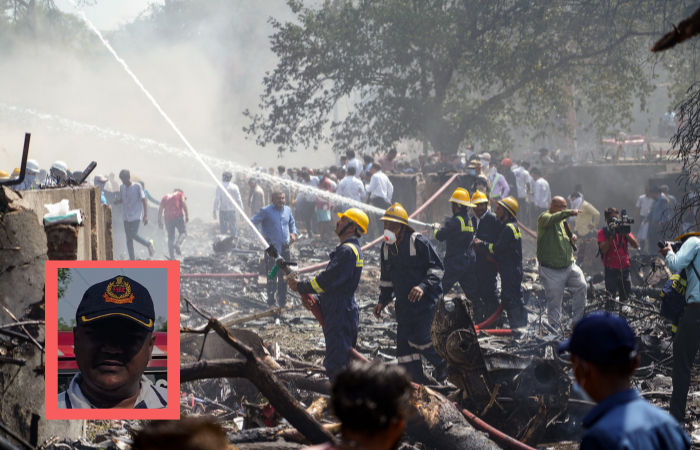
In one of the most devastating aviation tragedies the city has witnessed, officials from the Ahmedabad Fire and Emergency Services Department have detailed the massive scale of the response operation following the Air India Dreamliner crash on Thursday afternoon near the BJMC Boys Hostel in Meghaninagar.
Speaking to Gujarat Samachar Digital, Om Jadeja, divisional fire officer, confirmed that the control room received the distress call at 1.40 pm, just minutes after the aircraft crashed. "The fire had already engulfed a large area within 10 seconds of impact. The blaze reached temperatures as high as 1000°C, fuelled by the aviation gasoline (AVGAS) present in both aircraft fuel tanks," an officer said.
Largest fire response in recent city history
Over 60 fire vehicles and 130 firefighters from Ahmedabad Fire Services were rushed to the site, including Crash Fire Tenders (CFTs) specially designed to tackle aviation-related fires. “This was a high-risk carbon fire with flammable aircraft materials. Our personnel operated in extreme conditions,” said Swastik Jadeja, divisional fire officer.
In coordination with central and local agencies, 50 CISF personnel, 50 members from Civil Defence, 30 personnel from the NDRF, and 15 officials from the District Collectorate were deployed for search and rescue efforts. Additionally, 250 police personnel, 50 army officials, and disaster management teams joined the operation.
“The AMC also deployed 15 mechanical cranes and JCB machines to clear debris. We also had over 108 ambulances from emergency services ferrying casualties,” said a senior disaster response coordinator.
Rescue complicated by fuel, heat, and structural collapse
The aircraft reportedly crashed directly onto the hostel canteen building, then the aircraft's front part carrying passengers crashed into the three hostel buildings, causing large-scale structural damage. “At least 45 vehicles were gutted, and more than 35 casualties were confirmed at the hostel and nearby Doctor’s Colony,” the fire department stated.
Aviation fuel leakage further complicated rescue efforts. “We had to use special lifting and pulling equipment to extract victims trapped beneath debris. Around 30 firefighters were operating with 70% seat belt safety harnesses, given the risk of sudden flare-ups,” an official said.
Health emergencies and international response
More than 80 people reported health complications, mostly due to smoke inhalation and heat, during the ongoing operations. British Embassy officials, immigration authorities, and event organisers have visited the site, as a large number of victims were UK-bound passengers.
The fire department also confirmed that body identification will take up to 72 hours due to severe burns. “We’ve categorised victims into red, yellow, and green zones based on severity. So far, around 150 bodies have been recovered, many of them still with seatbelts strapped,” said an official overseeing triage.
Prepared, yet unprepared
Ironically, the city had conducted a mock drill on June 5, simulating a plane crash, in which many of the same teams participated. “Despite our preparedness, the scale and intensity of this crash have tested every limit,” said one official, visibly shaken.
A comprehensive damage assessment and loss calculation is underway. Meanwhile, DNA samples from victims are being collected, and identification processes are expected to take several days.
“We have never faced such a coordinated rescue involving this many agencies,” the fire official concluded, “but we are doing everything in our power to bring closure to grieving families.”
