




India’s gold demand shifts to investment in Q1 2026 amid global conflict, jewellery demand hit: Report
Updated: Apr 29th, 2026


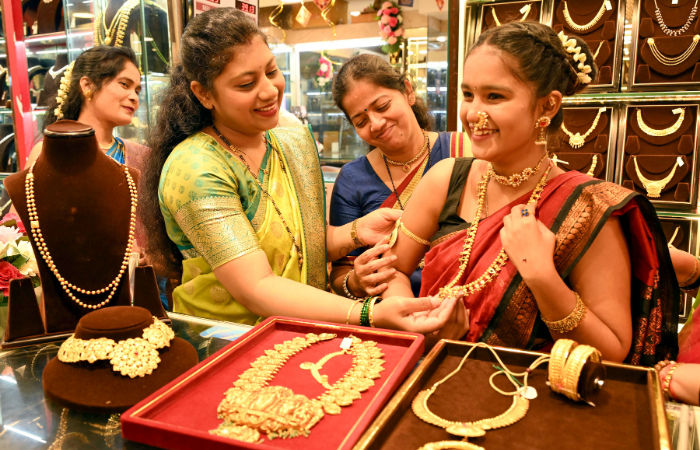
India mirrored the global shift in gold demand in Q1 2026, with investment demand strengthening even as jewellery demand came under pressure amid record-high prices due to global tensions and other factors.
Global trends: Yes to investment, no to jewellery
Global gold demand saw modest growth in volume but surged sharply in value in the first quarter of 2026, driven by strong investment demand and record-high prices. Total demand, including over-the-counter (OTC) transactions, rose 2% year-on-year to 1,231 tonnes, while its value jumped 74% to a record $193 billion, as per a report.
Bar and coin demand stood out, rising 42% to 474 tonnes, the second-highest quarterly level on record, led largely by strong buying from Asian investors.
At the same time, gold-backed ETFs (exchange-traded funds) recorded inflows of 62 tonnes, significantly lower than the 230 tonnes seen in Q1 2025, following notable outflows from US funds in March.
According to the ‘Global Demand Trends’ report by the World Gold Council, authored by Louise Street and Krishan Gopaul, central banks worldwide continued to play a key role, purchasing a net 244 tonnes of gold in Q1, marking a 3% annual increase despite higher selling activity during the period.
Demand from the technology sector edged up 1% to 82 tonnes, supported by continued growth in AI infrastructure.
Jewellery demand, however, remained under pressure due to elevated prices. Global volumes fell 23% year-on-year to 299.7 tonnes, the lowest since Q2 2020.
India’s jewellery consumption dips, value rises
While the value of jewellery demand rose 31% to a record $47 billion. In India, jewellery consumption declined 19% to 66.1 tonnes, and in China it dropped 32% to 85.2 tonnes.
Despite this, Indian jewellery demand reached a record $10 billion in value terms, due to an 81% rise in local gold prices.
Consumers increasingly shifted towards lighter-weight and lower-carat jewellery, with a clear divide between high-income buyers, who continued purchasing heavier items, and mass-market consumers, who reduced spending or opted for more affordable alternatives. Many buyers also moved towards bars and coins due to lower premiums.
Investment demands: India and global
Investment demand globally dipped 5% to 535.6 tonnes, but this masked a sharp divergence. Bar and coin demand surged, while ETF demand fell 73% year-on-year to 62 tonnes.
In India, bar and coin investment rose 34% to 62.3 tonnes, the highest first quarter level since 2013, nearly matching jewellery demand, a notable structural shift. China led globally, with bar and coin demand jumping 67% to 206.9 tonnes.
Strong inflows were also seen in Japanese funds, while Europe recorded minor outflows of 8 tonnes and North America saw a decline of 16 tonnes amid rising interest rates and a stronger US dollar.
Central to this shift has been gold’s price rally and geopolitical uncertainty, which continue to drive safe-haven demand.
Analysts expect these factors to remain dominant through 2026, supporting continued central bank buying, ETF inflows, and retail investment in bars and coins. However, ETF demand may not match 2025 levels if interest rates remain elevated, unless a major geopolitical factor, such as an escalation in West Asia, significantly disrupts global markets.
Supply and recycling
On the supply side, mine production is expected to increase further in response to high prices and margins. Recycling rose 5% year-on-year to 366 tonnes, with India recording a sharp 20% annual increase and 44% quarter-on-quarter rise. This was partly due to easing exchange trends and pressure on consumer finances.
However, recycling growth was constrained in regions such as the Middle East due to logistical challenges linked to geopolitical tensions, and in Europe and North America due to capacity limitations.
Gold demand in industrial applications declined slightly, with usage in other sectors falling 8% to 10 tonnes, while gold use in dentistry dropped below 2 tonnes for the first time, as alternatives like ceramics gained traction.
Looking ahead
Investment demand is expected to remain positive but below 2025 levels. In India, strong price momentum, geopolitical risks and limited alternative investment options are likely to sustain demand for bars, coins and ETFs.
However, factors such as a weak monsoon or inflationary pressures could impact purchasing power. Meanwhile, jewellery demand is expected to remain subdued globally due to persistently high prices and economic uncertainty, with China’s VAT changes further dampening demand and pushing consumers towards investment products.
Overall, the first quarter highlighted a clear shift in gold demand dynamics, away from jewellery and towards investment, as high prices and global uncertainty reshape consumer and institutional behaviour across markets.
