

Bombay HC Puts Onus of Losses on Traders, Not Regulator

Bombay High Court rules that SEBI and exchanges are not responsible for insulating F&O traders from losses. Read the brutal truth behind the MCX crude oil ruling and SEBI's reality check.
Summarized by AI; it may make mistakes. Check important info
Bombay High Court rules that SEBI and exchanges are not responsible for insulating F&O traders from losses. Read the brutal truth behind the MCX crude oil ruling and SEBI's reality check.
Summarized by AI; it may make mistakes. Check important info

In a major reality check for derivative investors, the court rules SEBI cannot act as a 'nursemaid' to absorb market risks.
Think the stock market has a safety net for your bad trades? Think again. The financial markets are a zero-sum battlefield, and if a black swan event hits, market movement is supreme. Neither the exchange nor the regulator is coming to save your wallet.
Two massive, sobering developments—a landmark ruling by the Bombay High Court and devastating multi-year data from the Securities and Exchange Board of India (SEBI)—have laid bare the unvarnished reality of trading in India. The ultimate message to retail investors is loud and clear: Take the risk, but prepare to bleed the capital. You are entirely on your own.
The Legal Reality: No Safety Nets for Speculation
A stark reminder of absolute market risk came from the Bombay High Court when it dismissed a batch of petitions filed by commodity traders against the Multi Commodity Exchange (MCX) and the market regulator.
The dispute traced back to the unprecedented COVID-19 demand collapse in April 2020, when global crude oil prices crashed below zero, settling at a shocking negative price of (-)₹2,884 per barrel. Traders holding long positions were financially decimated. They dragged MCX and SEBI to court, demanding their losses be artificially capped at ₹1, claiming they were trapped by altered pandemic trading hours and extreme volatility.
The division bench of Justice R.I. Chagla and Justice Advait M. Sethna flatly rejected the traders' pleas, laying down standard principles that every retail trader should tattoo on their terminal:
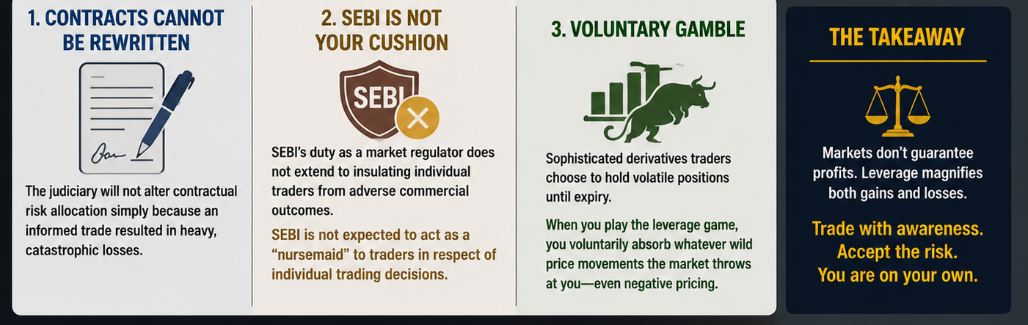
Contracts Cannot Be Rewritten: The judiciary will not alter contractual risk allocation simply because an informed trade resulted in heavy, catastrophic losses.
SEBI is Not Your Cushion: Crucially, the High Court ruled that SEBI’s duty as a market regulator does not extend to insulating individual traders from adverse commercial outcomes arising from their own trading choices. As the bench sharply noted, SEBI is not expected to act as a "nursemaid" to traders in respect of individual trading decisions.
Voluntary Gamble: Sophisticated derivatives traders choose to hold volatile positions until expiry. When you play the leverage game, you voluntarily absorb whatever wild price movements the market throws at you—even negative pricing.
The Statistical Reality: The Grim Math of Retail F&O Trading
If you think the commodity market is an isolated extreme, look at the equity Futures & Options (F&O) segment. Millions of retail investors treat options trading as a casual side-hustle or a quick lottery. However, SEBI’s exhaustive data tracking paints a horrifying picture of wealth erosion.
The Realities of Individual Equity F&O Trading (SEBI Study)
Metric Evaluated | The Hard Reality |
Individual Loss-Makers | 93% of all retail traders lose money (Over 9 out of 10 individuals) |
Total Wealth Eroded | Over ₹1.8 Lakh Crore (₹1.8 trillion) in net losses over a 3-year period |
Average Cost of Admission | Loss-making individuals lose an average of ₹2 Lakh each (inclusive of transaction costs) |
The 1% Outliers | Only 1% of individual retail traders manage a net profit exceeding ₹1 Lakh |
The math refuses to budge. Year after year, over 90% of retail participants finish in the red.
So, who is making the money? SEBI’s analytics reveal that the profits are overwhelmingly pocketed by Foreign Portfolio Investors (FPIs) and algorithmic proprietary trading desks. These institutions use high-frequency trading (HFT) models, lightning-fast colocation servers, and hyper-advanced data arrays. The average retail trader looking at a mobile screen while sitting at home is quite literally bringing a pocket knife to a laser fight.
The Takeaway
Market volatility is a force of nature. When extreme movements happen, price action moves with absolute authority. The job of an exchange or SEBI is to ensure market integrity and functional infrastructure—not to protect your bank account from a bad bet.
If you choose to trade derivatives, you must abandon the hope of a bailout. Every single order requires an explicit, fully informed understanding of leverage, risk management, and market volatility. Approach the terminal with absolute humility, because if the market turns against you, no one is coming to save you.


