




Adani to invest ₹2 lakh crore in nuclear and conventional power
Updated: Jun 24th, 2026


Adani Group Chairman Gautam Adani on Wednesday unveiled a roadmap for the conglomerate’s next phase of growth, backed by major investments across power generation, nuclear energy, hydropower, digital infrastructure, healthcare, aerospace and skill development.
The Group is implementing India’s largest private-sector power capex programme worth over ₹2 lakh crore, targeting 45 GW of generation capacity in the next five years, while also pursuing 10 GW of nuclear energy capacity by 2035, a 3 GW data centre platform by 2030, 5,000 MW hydropower projects in Bhutan, integrated healthcare campuses in Ahmedabad and Mumbai, and large-scale rural skilling initiatives across India.
Addressing the Adani Group’s 34th Annual General Meeting (AGM) 2026, Gautam Adani laid out three foundational steps that will drive the organisation’s vision over the next decade — to build infrastructure that powers India and institutions that ensure human dignity at every level of society.
“The future will demand more ambition, more discipline and more execution than ever before.
But together, we stand ready - ready to build, ready to serve, and ready to help shape the India whose greatest days lie ahead,” Gautam Adani said.
Major investments across energy, digital and aerospace sectors
At Adani Power, the Group is implementing India’s largest-ever private-sector power capex programme worth more than ₹2 lakh crore, with a target of reaching 45 GW of capacity over the next five years.
The Group is also partnering with Bhutan’s Druk Green Power Corporation (DGPC) to jointly develop 5,000 MW of hydropower projects in Bhutan.
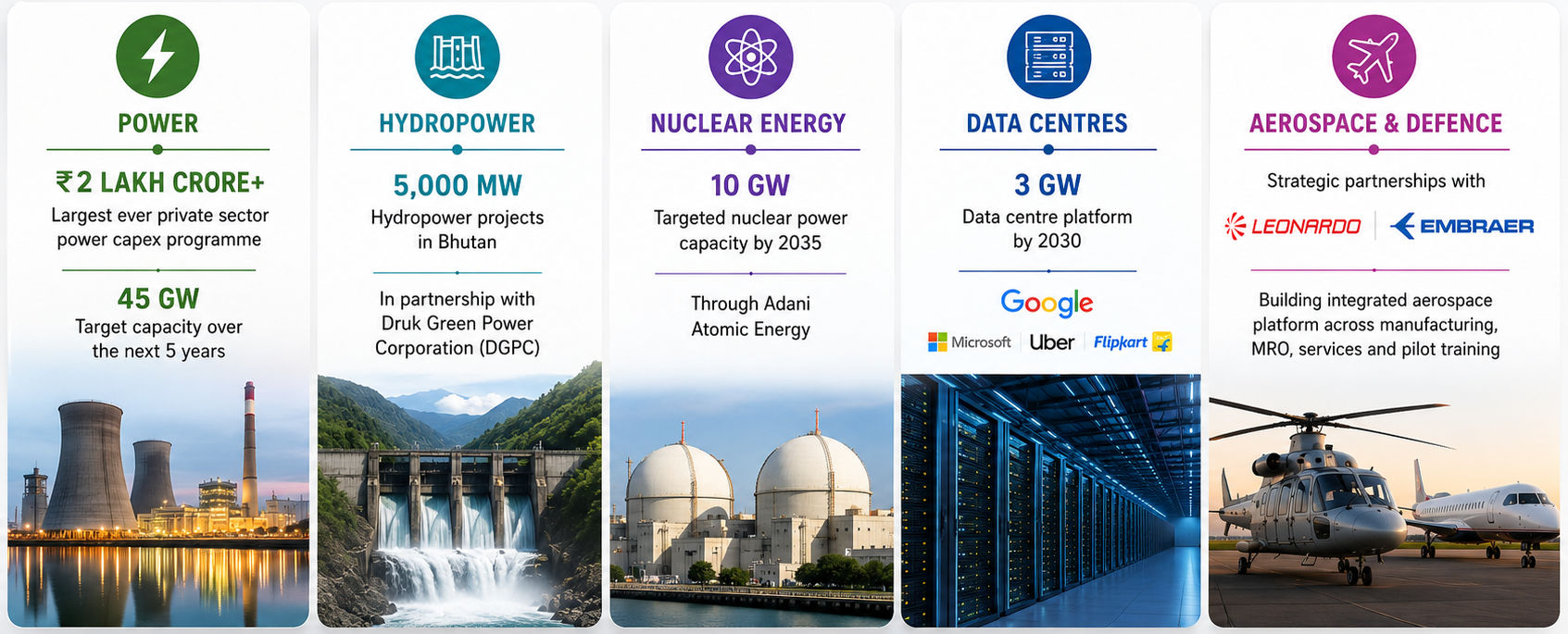
Its entry into nuclear energy through Adani Atomic Energy marks another major expansion, with land already identified and a target of building 10 GW of nuclear power capacity by 2035.
In digital infrastructure, the Group’s Data Centre business is on track to create a 3 GW platform by 2030. The company has already signed a binding MoU with Google for a gigawatt-scale data centre in Visakhapatnam, while global technology firms including Microsoft, Uber and Flipkart continue to partner with Adani’s digital infrastructure platform.
The Group is also expanding its presence in defence and aerospace through partnerships with Leonardo and Embraer.
“Our partnerships with Leonardo and Embraer are helping lay the foundation for integrated helicopter and regional aircraft manufacturing ecosystems in India. We are building a national aerospace platform that spans manufacturing, MRO, services and pilot training,” Gautam Adani said.
Healthcare, education and rural skill development
Alongside business growth, Gautam Adani said the Adani Foundation remains central to the Group’s broader purpose. The Foundation currently reaches nearly 10 million people across 7,000 villages in 22 states and is entering its 30th year under the leadership of Dr Priti Adani.
“In healthcare, we are building one of India’s most ambitious rural vision care model ecosystems in Bihar, combining all aspects of affordable eye care. Through the Adani University of Higher Education and Research and the Gujarat Adani Institute of Medical Sciences in Bhuj, we are now also creating Centres of Excellence in affordable healthcare education and delivery,” the Adani Group Chairman informed.
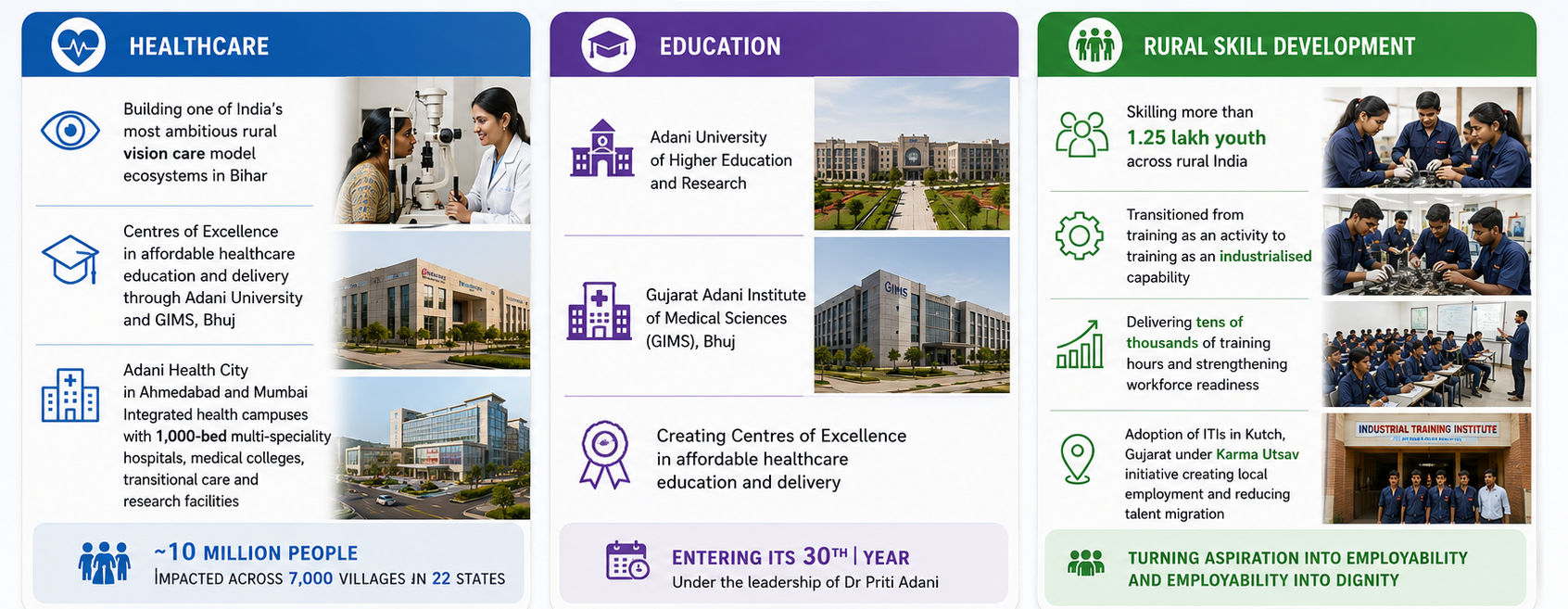
The Group is also developing Adani Health City projects in Ahmedabad and Mumbai, featuring integrated healthcare campuses with 1,000-bed multi-speciality hospitals, medical colleges, transitional care facilities and research centres.
On skill development, Gautam Adani highlighted that the Group is currently skilling more than 1.25 lakh youth across rural India.
“Coming to skill development, we are skilling more than 1.25 lakh youth across rural India, turning aspiration into employability and employability into dignity,” Gautam Adani highlighted.
This year, the Group transitioned from training as an activity to training as an industrialised capability, delivering tens of thousands of training hours and strengthening workforce readiness. In Kutch, Gujarat, the adoption of Industrial Training Institutes (ITIs) under the Karma Utsav initiative is helping create local employment opportunities and reduce talent migration.
Simplifying operations and strengthening accountability
“First, we are simplifying the way we work. We are putting in place a three-layer structure across both our headquarters and our sites to reduce bureaucracy, sharpen accountability, and bring decisions closer to execution. Every role, every process, and every layer must add value. Non-core activities will move either to our GCCs or to nominated partners,” said the Adani Group Chairman.
Second, the Group is restructuring its engagement with contractors.
“We see them as long-term partners in nation-building. We will build deeper, more stable partnerships where their growth is supported, their margins are protected, and their interests are aligned with ours to help us deliver projects with greater speed, quality and ownership,” Gautam Adani stressed.
Third, and most importantly, “we are placing worker-dignity at the heart of our transformation”.
“Across our own and contractor workforce of nearly four lakh people, almost 85% are people who work on the ground at our sites. They are the people who turn our plans into reality. And we are committed to ensuring that every worker is treated with dignity. This means clean living conditions, hygienic food, access to medical support, safe working environments and fair wages paid on time,” said the billionaire industrialist.
