

VIP Escorts vs Steel Barricades: How Ahmedabad Police Cleared Road For BJP Rally While Cracking Down On Dissent

Summarized by AI; it may make mistakes. Check important info
Summarized by AI; it may make mistakes. Check important info

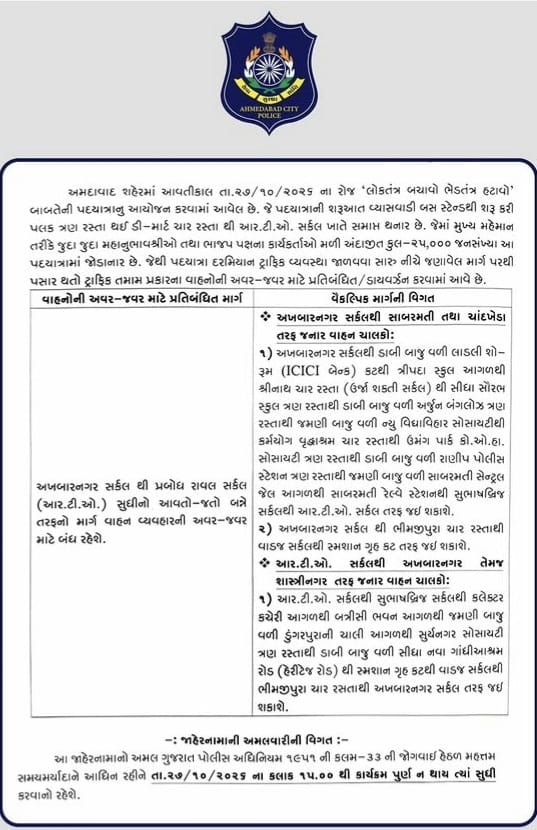
Ahmedabad City Police closed a three-kilometre stretch of the 132 Feet Ring Road on Monday, diverting thousands of commuters to facilitate a 25,000-strong Bharatiya Janata Party (BJP) rally while opposition demonstrations in Gujarat continue to face strict curbs.
The traffic advisory, issued under Section 33 of the Gujarat Police Act, blocked both directions of movement between Akhbarnagar Circle and Prabodh Raval Circle from 3:00 PM onwards. The order cleared a dedicated corridor for the ruling party’s Loktantra Bachao, Bhedtantra Hatavo padyatra, which marched from Vyaswadi Bus Stand to R.T.O. Circle.
One Corridor, Two Standards Of Policing
While city authorities deployed traffic personnel and published pre-planned detour maps across social channels for the BJP march, civil society groups and opposition figures point to a stark contrast in administrative approvals.
Law enforcement agencies frequently enforce Section 163 of the Bharatiya Nagarik Suraksha Sanhita (BNSS)—formerly Section 144 of the CrPC—to prevent assemblies by student unions, farmer collectives, and rival political factions. In those instances, police routinely cite potential traffic disruptions or public inconvenience as grounds to deny permits, placing steel barricades along major intersections and pre-emptively detaining organizers.
Lawyers and policy experts argue that this selective enforcement clashes directly with constitutional protections under Article 19(1)(b), which guarantees all citizens the right to assemble peacefully without arms.
Legal Mandate Versus On-Ground Execution
Supreme Court rulings in landmark matters, including the 2012 Ramlila Maidan judgment and the 2018 Mazdoor Kisan Shakti Sangathan case, established that police powers regarding public assemblies must remain purely facilitative. The apex court held that state administration holds a duty to enable freedom of expression while managing local traffic rather than using administrative power to block peaceful gatherings.
"When a ruling party requests a route, the police act as event coordinators," said a senior legal advocate in Gujarat specializing in constitutional rights. "When an opposition group requests a venue, the police act as security guards protecting the city from its own citizens."
Police officials maintain that clearance decisions rely strictly on security assessments, route capacity, and crowd volume estimates rather than political affiliations.
Commuters Bear The Cost Of Political Marches
Monday's shutdown along the Akhbarnagar-R.T.O. belt forced thousands of daily commuters, freight transporters, and delivery agents into narrow residential side streets throughout Ranip and Vadaj.
When state agencies shut down core urban corridors for ruling party events, they demonstrate that traffic disruption is manageable when backed by executive authority. Using public inconvenience as an argument to deny assembly permits to critical voices while clearing prime transit arterial routes for official rallies shows how administrative discretion controls public space.
The disparity in accessing public corridors creates a system where opposition groups, denied official permits, must either cancel plans or risk illegal assembly charges and detention. As long as local law enforcement treats political assemblies differently based on who holds office, equal protection under the law stays tied to executive approval.


